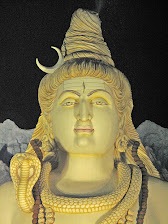
Search From Here

Thursday, February 11, 2010

Mahashivratri 2010 at Date 12th February 2010

This year
Mahashivratri
falls on

12th February 2010
when the Shiva principle descends to Earth
a thousand times more than usual.
On this day, to obtain the full benefit of
Lord Shiva's principle,
one should chant

'Om Namah Shivaya'
as much as possible.


Shivratri
is the time when Shiva takes a rest.
Shiva rests for one 'prahar' (three hours) of the night..
This 'prahar' is referred to as the Shivratri.
When Lord Shiva takes rest, the function of
'Shivtatva' (Shiva Principle) ceases,
i.e. Lord Shiva goes into a meditative state.


Shiva's meditative state is the time when
He is engrossed in His own spiritual practice.

During that time,
the 'Shivtatva' does not accept any tamogun
(most base of the 3 elements in us - sattva, raja & tama)
or
any halahal (venom churned from the ocean)
coming from the Universe.
As a result,
the ratio of halahal or the pressure
of the negative energies increases.
For protection from this pressure, things like
'bilva patra', white flowers, 'rudraksha' beads etc
are offered to Lord Shiva.

These things attract the 'Shivtatva' from the atmosphere,
thus providing protection from the increasing
effect of the negative energies.
The Earth is a gross object.
Gross objects have very low velocities
i.e. they require more time to cover a specific distance in space.
Gods on the other hand, are subtle hence they
are capable of traversing space within a few seconds.
That is why one year on the earth
is equivalent to just one day of heaven.

Science in the worship of
Lord Shiva on Mahashivratri

The function of the
'Shivpindi'


1.
Emitting waves of Knowledge,
Devotion and renunciation

Predominantly
'sattva' waves of knowledge,
'raja' waves of devotion
and
'tama' waves of Renunciation (Vairagya)
are emitted by the 'Shivpindi'.

During Mahashivratri,
the emission increases by 30 percent.

2..
Emission of subtle vibrations
of chaitanya, bliss and peace

The 'Shivpindi' emits

subtle vibrations of chaitanya, bliss and peace.
During the Mahashivratri,
the emission increases by 25 percent.
This helps purify the subtle-body of
one who worships the Shivpindi on this day.
The 'sun' or the 'moon' channels
in the body get activated as per necessity.
The capacity to absorb the sattvaguna
and chaitanya also increases.
Due to the presence of the unmanifest
Shiva principle in the Shivpindi
and the vibrations of peace emitted,
the Shivpindi remains cool and the
mind too experiences peace.
Worship of Shivpindi with devotion,
activates the dormant Shiva principle.
An offering of puffed rice and milk
reaches Lord Shiva in the subtle form.

3.
Receiving the
'tarak or marak tatva (element)'
as required

There is a confluence of the manifest
and the unmanifest elements along with the
'tarak and marak tatva' in the Shivpindi.
(Tarak = Saviour; Marak = Destroyer).
That is how worshipers receive the required element.
The temperature of the Shivpindi increases due
to the emission of the marak tatva
and there one experiences bliss.
Similarly,
when the tarak tatva is emitted,
the temperature drops and one experiences peace and bliss.

Bilvapatra (Bel leaves)


Bilvapatra contains 2% Shiva tatva.
By offering bilvapatra to the Shivpindi on Mahashivratri,
the manifest Shiva tatva near the stalk of
the bilvapatra gets activated.
Due to this, waves of chaitanya as well as Shiva tatva
are emitted by the bilvapatra.

The bilvapatra
attracts 20% of the Shiva tatva present in
the Shivpindi towards itself.
By immersing this bilvapatra
in water or by placing it in grains,
the Shiva tatva present in the bilvapatra is transmitted to them.
The Shiva tatva in the bilvapatra
is activated to a larger extent on Mondays
when it transmits 10% of the Shiva tatva and sattvikta.
On other days only 1% of the Shiva tatva
is activated in the bilvapatra.

Bilvarchan

Offering bilvapatra
to the Shivpindi and chanting the mantra

'Om Namah Shivaya'


with each offering is known as bilvarchan.
Continue offering the bilvapatra until the pindi
is completely covered.
Offer the bilvapatra from the lower part of the pindi.
By starting from the feet of the idol,
more benefit is derived and the idol
can be covered completely.

Chanting on Mahashivratri

'Om Namah Shivaya'

Om represents an unmanifest state beyond
the 3 gunas (elements of sattva, raja & tama).
We bow to Lord Shiva, from whom Om was created.

What does the word 'Shiva' mean?

a.
The word Shiva has been derived
by reversing the letters of the word vash.
Vash means to enlighten; thus the one
who enlightens is Shiva.
He remains radiant and also illuminates the universe.

b..
He is the auspicious and
prosperity-bestowin g principle.

Some unique attributes

1. Physical attributes

a. Ganga :
Just as the sun is the focal point of the solar system
and the soul that of the body,
the focal point of divine consciousness
(chaitanya) in every object and
pure particles (pavitrakas) is ga-aum.
The flow from which ga-aum originates is gan gaha = Ganga.
Ga-aum flows from Shiva's head.
This is called the descent of the Ganga
from Shiva's head.
Since the river Ganga has a fraction
of the principle of the spiritual Ganga,
no matter how polluted it becomes,
its purity is perpetually retained.

Hence,
when compared to any other water in the world,
the water from the Ganga is the purest.
This is realised not only by those
who can perceive the subtle dimension
but also by scientific researchers.

b. Moon :
Shiva adorns the chandra (moon) on His forehead.
The point where the three frequencies
- affection (mamata), mercifulness (kshamashilata)
and motherly love (vatsalya) originate
is referred to as the chandra (moon).
Thus, one can conclude that chandrama
(the moon principle) is the state in
which the three attributes of affection,
mercifulness and motherly love are present.

c. Third eye :
Shankar is three-eyed,
i.e. He can perceive events of the past, present and future.
According to the science of Yoga
the third eye means the Sushumna nadi (channel).

d. Serpent :
One of the Names of Lord Shankar is Bhujanga-patihari.
Bhujang means a serpent or pure particles (pavitrakas) ,
pati means the nurturer and hari means one
with a garland around His neck.
Bhujangapatihari thus means the One
who nurtures pure particles and wears them like a garland.
Various serpents represent groups of pure particles.
Though externally they appear like serpents,
internally they are a kind of ladder.
To make spiritual progress one has to climb
up holding onto the tail of the serpent.
Lord Shankar adorns serpents at nine points on His body
- one on the head,
one around the neck,
one on each arm,
one on each wrist,
one around the waist and
one on each thigh.
This implies that His body is comprised
of pure particles or that serpents of pure particles
play all over the body of Lord Shankar
who has the universe as His form.

2. Spiritual attributes

a.. One performing severe
austerities and the great yogi

Shiva is always seated in a bandha or a mudra.
His temperature rises due to heat generated
by performing severe austerities;
Hence, He uses the Ganga, the moon and
serpents which endow a cooling effect
and lives on the snow-clad Kailas mountain.

b.. Short tempered
If someone disturbs His meditation
the radiance generated by spiritual practice
will be suddenly expelled and whoever is in front of Him
will not be able to tolerate it, and gets destroyed.
This is referred to as being 'reduced to ashes
by Shankar's opening of the third eye'.

c..
One who is willing to undergo
any distress for the sake of imparting happiness to others

The poison
generated during the churning
of the celestial ocean (samudramanthan)
was burning the entire Universe but no deity
came forward to accept it.
At that time Shiva drank that poison
and saved the world from destruction.

d.
One who has both,
deities and demons, as His worshippers

Neither did demons
like Banasur, Ravan, etc.
worship Lord Vishnu nor did Lord Vishnu bestow
any boon upon any demon.
However, they worshipped Lord Shiva who blessed them.

e. Master of the spirits

Since Lord Shiva is the master of spirits,
His worshippers are generally not possessed by them.

Science in the idol - in the Human form


This represents the Brahman
in the form of the word (shabda Brahman).
Alphabets consisting of the sounds of
fifty-two basic letters and the forms
of fourteen Maheshvar verses (sutras)
have generated from it.
Later the universe was created from these.

2. Trident :
represents the following -

The three components - sattva, raja and tama
The root of creation, sustenance and dissolution
Volition, knowledge and action

3. Noose (pash) :
The noose represents the noose of time (kalpash)
(The rope in Lord Ganapati's hand too is the same).

Worship

a. Application of holy ash (Bhasma)

Tripundra refers to the three horizontal
stripes of holy ash applied to the forehead.
These stripes symbolise spiritual knowledge,
purity and penance (spiritual practice of Yoga),
so also they represent the three eyes of Lord Shiva.

b.. Wearing a rudraksha

Wearing a rudraksha when worshipping Lord Shiva is ideal.
A rudraksha is reddish in colour with yellow stripes
and is flat like a fish.
On one side it has a slight opening which
appears like an open mouth.
The rudraksha converts light frequencies of deities
from the universe into sound frequencies in the
body of humans and vice versa.
As a result, humans can absorb frequencies of deities
and thoughts can get converted into the language of deities.

A Genuine Rudraksha

The rudraksha absorbs sama (sattva) frequencies.
Similarly sama frequencies are emitted by its crests.
A real rudraksha can be recognised by the
vibrations felt by holding it in the hand.
At that time the body absorbs the
sama frequencies emitted by the rudraksha.

Nowadays,
mostly Vikrutaksha is sold as a rudraksha.
This is the seed of a type of wild berry.
Vikrutaksha is used for sacrificial fires of
tantriks, black magic etc.
by sorcerers.

c.. Ritualistic worship of the pindi

Only cold water and bel is offered
to Lord Shankar's pindi.
Neither is it bathed with milk and panchamrut
(a mixture of milk, curds, ghee, sugar and honey)
nor offered turmeric, vermilion (kumkum)
or white consecrated rice (akshata).
Milk and clarified butter (ghee) symbolise sustenance
while turmeric is an underground stem and represents
fertility of the soil, that is creation.
Vermilion is prepared from turmeric.
Since Lord Shiva is the deity of dissolution,
substances such as milk, vermilion and
turmeric are not used in His worship.

d. Circumambulation
(pradakshina)

When circum-ambulating one should begin
from the left side and continue till the channel
of the shalunka from where the water offered
during the ritualistic bathing (abhishek) flows.
Without crossing it one should complete
a circum-ambulation by moving in the reverse direction up
to the other side of the channel.
The flow of a shalunka is not crossed
as it is the flow of energy which adversely
affects the formation of semen and
the five internal vital energies (pran vayu).

e. Chanting the Name of Lord Shiva

'Namaha Shivaya is Shiva's five-syllabled mantra.
The spiritual meaning of each of the five syllables is:
na = Foremost deity of all the regions (lokas)
ma = Bestower of supreme spiritual knowledge (gyan)
and redeemer of the greatest of sins
shi = Benevolent, serene and responsible for
initiation by Lord Shiva
va = Symbolic of a bull as the vehicle
and Vasuki and Vamangi energy (shakti)
ya = Auspicious abode of Supreme Bliss and Lord Shiva.
Hence, obeisance (namaskar) to these five syllables.


Hinduism is more a way of life than a method of worship.

Dharmo Rakshati Rakshithaha

If you protect Dharma, Dharma will in turn protect you.

Hindus, If people slap you once, slap them twice

Please must give your comments on this article.

Tuesday, June 9, 2009

Birth of Lord Shiva.

Birth of Lord Shiva.


According to one legend, shiva initial materialize when Brahma and Vishnu were arguing regarding which of them was more powerful. Their quarrel was interrupted by the unexpected look of a large burning pillar whose roots and branches complete outside sight into the earth and sky. Brahma became a goose and flew up to locate the top of the pillar, even as turned into a boar and dug in to the ground to appear for its roots. Unsuccessful in their search, the two god’s arrival and saw Shiva surface from an opening in the support. Recognize Shiva’s huge power, they established him as the third ruler of the universe.

Lord Shiva-God of formation of universe and he is as well referred has destructor. His huge position is to balance the good and evil events. Though this balance gets disturb he destroys the creation for the formation of next cycle. He is a deity of exercise in the cyclic practice of formation.


Lord Shiva is the lord of mercy. He guards the devotees since evil forces, trouble and suffering of their devotees.

He materialize with unclad body through tiger skin in his body, three matted locks on his head, Goddesses Ganga on his chief and he has a third eye and has a snake on his correct shoulder and he wear Kundalas, Rudraksha necklace.

He materialize with unclad body through tiger hide in his body, present matted locks on his skull, Goddesses Ganga on his skull and he has a third eye and has a snake on his correct accept and he wears kundalas, Rudraksha necklace.


His exterior symbolizes his behavior. The unclad body shows that he is a resource of whole universe. 3 metted locks are the integration of material, mental and spiritual energies. Goddesses Ganga shows destruction of sin, knowledge and bestows with information, peace and cleanliness. The third eye indicates the religious information and power. While he opens the third eye, the rotation of construction starts. The 108 beads represent the elements used in making of the earth. The tiger skin represents his potential power.

Lord Shiva has 1,008 names, including Mahadeva, Mahesh, Rudra, Neelkantha, and Ishwar. He is also called Mahayogi, or the huge ascetic, who represent the main form of serious penance and abstract thought, which results in salvation Shiva is supposed to survive in many variety. His mainly regular illustration is as a dark-skinned severe with a blue throat. Typically seated cross-legged on a tiger skin, Shiva’s hair is matted and coiled on his chief, adorned with a snake and a crescent moon. Ganga is forever depicted smooth out of his topknot.

Shiva has four arms and three eyes. The third eye, in the center of his forehead is forever closed and simply opens to destroy an evil doer. A garland of skulls, rudraksha bead, or a snake hangs from his neck. Lord Shiva also carries snakes as armlets and bracelets. The serpent, contest, despised and fear by all further creatures, establish a place of honour on Shiva’s holy being, just because he was enthused by their plight.


In single offer, Shiva hold his trishul, the Pinaka the trishul regularly has a damaru or wait beat joined to it. In a different hand, he holds a conch defense, and in the third, a rudraksha rosary, a club, or a bow. Individual hands are typically empty, raised in an indication of approval and defense. The added points to his foot, anywhere the devotee is certain of salvation. He carries a tiger or leopard skin around his waist, and his high body is typically bare, but dirty with ashes, as befits an ascetic.


His third eye is supposed to have emerged when Parvati, in a playful mood, covered his eyes with her hands. At once, the universe was plunged into darkness and there was chaos. To restore arrange, Shiva created a different eye on his forehead, from which emerged fire to return light.
The light from this eye is supposed to be extremely influential, and as a result destructive. Shiva opens his third eye only in anger, and the criminal is burnt to cinders.

The name Lord Shiva does not emerge in the Vedas. Though he is recognized with the Vedic god Rudra, lord of songs, sacrifice, and nourishment, the healer of diseases and provider of property. According to the Shiva Purana Shiva is said to contain five faces, related to his five tasks, the panchakriya formation, organization, destruction, awareness, and grace. His five faces are related with the formation of the holy syllable Om.

Shiva is supposed to live o Mount Kailash, a mountain in the Himalayas. His vehicle is Nandi the bull and his weapon, the trishul. Shiva’s wife is Parvati, who is as well thought to be a part of Shiva. One of the mainly well-liked forms of Shiva is that of Ardhanarishvara.


According to a legend in the Puranas, Brahma was ineffective of making. He propitiated Shiva who catch this form and separated Parvati from his body. Parvati has numerous incarnations, like Kali, Durga, and Uma. Their sons are Kartikeya and Ganesh.

Bhagwan God Shiva is invented to contain a huge number of attendants, called ganas. These mythological beings have human bodies with animal heads. Bhagwan Shiva’s son Ganesha is the head of the ganas.

Across the state, present are hundreds of holy place and shrines devoted to shiva. He typically worshipped in the structure of a Shivalinga, and also as a deity. He is worshipped by offering flowers, except the Ketaki Brahma Bel trees, milk, and sandalwood attach are also nice to him. Present is a particular arati to shiva and numerous hymns and poems in his praise.

Present there is lot of stories in the Puranas about the origin of Shiva According to the Vishnu Purana, at the establishment of this kalpa Brahma required a child and meditated for one. At present, a child appeared on his lap and started crying. While asked by Brahma why he was crying, the child replied that it was because he did not have a name Brahma then named him Rudra, meaning “howler”.

Though the child cried seven added times and was given seven more names. Shiva as a result has eight forms: Rudra, Sharva, Bhava, Ugra, Bhima, Pashupati, Ishana, and Mahadeva, which, according to the Shiva Purana, write to the earth, water, fire, wind, sky, a yogi called Kshetragya, the sun, and the moon respectively. Throughout the samudra manthan, when poison was churn out of the ocean, Shiva is said to have swallowed it to save the planet from destruction. Since he drank the poison, Parvati clasped his throat securely so that the poison was churned out of the ocean, Because of this, he is known as Neelkantha, the blue-necked one.


Bhagwan Shiva decided an irregular boon to a demon called Bhasmasura who wish that if he situated his hand on anyone’s leader, that person would turn to ashes. No earlier was his need resolute than he menaced Shiva himself, who took to his heels and was saved by Vishnu in the form of Mohini, mutual their energies and formed Hari-hara putra later, recognized with Sasta or Aiyappa, a celibate tribal deity in kerala, whose cult is currently huge in India. He lives on in Mohiniattam, the feminine equal of Kerala’s dance theatre, Kathakali.


Bhagwan Shiva is the maker of dance and of the initial 16 rhythmic syllables still uttered, since which the Sanskrit language was born. His dance of anger is called the Roudra Tandava and his dance, and they begged him to dance over. Lord Shiva promised to do so in the heart of his devotees and in a blessed grove in Tamil Nadu, everywhere the great temple of Chidambaram was build, the merely one in all Indian devoted to Shiva as Nataraja, the lord of dance. It is supposed that on the 13th day of every bright lunar fortnight after 6 o’clock in the evening, falls a blessed hour called Pradosha Worshipping Lord Shiva at this time is akin to worshipping all the powers.

Monday, February 16, 2009

Mahashivratri 2009, 23rd February 2009

This year
Mahashivratri
falls on

23rd February 2009
when the Shiva principle descends to Earth
a thousand times more than usual.
On this day, to obtain the full benefit of
Lord Shiva's principle,
one should chant

'Om Namah Shivaya'
as much as possible.


Shivratri
is the time when Shiva takes a rest.
Shiva rests for one 'prahar' (three hours) of the night..
This 'prahar' is referred to as the Shivratri.
When Lord Shiva takes rest, the function of
'Shivtatva' (Shiva Principle) ceases,
i.e. Lord Shiva goes into a meditative state.


Shiva's meditative state is the time when
He is engrossed in His own spiritual practice.

During that time,
the 'Shivtatva' does not accept any tamogun
(most base of the 3 elements in us - sattva, raja & tama)
or
any halahal (venom churned from the ocean)
coming from the Universe.
As a result,
the ratio of halahal or the pressure
of the negative energies increases.
For protection from this pressure, things like
'bilva patra', white flowers, 'rudraksha' beads etc
are offered to Lord Shiva.

These things attract the 'Shivtatva' from the atmosphere,
thus providing protection from the increasing
effect of the negative energies.
The Earth is a gross object.
Gross objects have very low velocities
i.e. they require more time to cover a specific distance in space.
Gods on the other hand, are subtle hence they
are capable of traversing space within a few seconds.
That is why one year on the earth
is equivalent to just one day of heaven.

Science in the worship of
Lord Shiva on Mahashivratri

The function of the
'Shivpindi'


1.
Emitting waves of Knowledge,
Devotion and renunciation

Predominantly
'sattva' waves of knowledge,
'raja' waves of devotion
and
'tama' waves of Renunciation (Vairagya)
are emitted by the 'Shivpindi'.

During Mahashivratri,
the emission increases by 30 percent.

2..
Emission of subtle vibrations
of chaitanya, bliss and peace

The 'Shivpindi' emits

subtle vibrations of chaitanya, bliss and peace.
During the Mahashivratri,
the emission increases by 25 percent.
This helps purify the subtle-body of
one who worships the Shivpindi on this day.
The 'sun' or the 'moon' channels
in the body get activated as per necessity.
The capacity to absorb the sattvaguna
and chaitanya also increases.
Due to the presence of the unmanifest
Shiva principle in the Shivpindi
and the vibrations of peace emitted,
the Shivpindi remains cool and the
mind too experiences peace.
Worship of Shivpindi with devotion,
activates the dormant Shiva principle.
An offering of puffed rice and milk
reaches Lord Shiva in the subtle form.

3.
Receiving the
'tarak or marak tatva (element)'
as required

There is a confluence of the manifest
and the unmanifest elements along with the
'tarak and marak tatva' in the Shivpindi.
(Tarak = Saviour; Marak = Destroyer).
That is how worshipers receive the required element.
The temperature of the Shivpindi increases due
to the emission of the marak tatva
and there one experiences bliss.
Similarly,
when the tarak tatva is emitted,
the temperature drops and one experiences peace and bliss.

Bilvapatra (Bel leaves)


Bilvapatra contains 2% Shiva tatva.
By offering bilvapatra to the Shivpindi on Mahashivratri,
the manifest Shiva tatva near the stalk of
the bilvapatra gets activated.
Due to this, waves of chaitanya as well as Shiva tatva
are emitted by the bilvapatra.

The bilvapatra
attracts 20% of the Shiva tatva present in
the Shivpindi towards itself.
By immersing this bilvapatra
in water or by placing it in grains,
the Shiva tatva present in the bilvapatra is transmitted to them.
The Shiva tatva in the bilvapatra
is activated to a larger extent on Mondays
when it transmits 10% of the Shiva tatva and sattvikta.
On other days only 1% of the Shiva tatva
is activated in the bilvapatra.

Bilvarchan

Offering bilvapatra
to the Shivpindi and chanting the mantra

'Om Namah Shivaya'


with each offering is known as bilvarchan.
Continue offering the bilvapatra until the pindi
is completely covered.
Offer the bilvapatra from the lower part of the pindi.
By starting from the feet of the idol,
more benefit is derived and the idol
can be covered completely.

Chanting on Mahashivratri

'Om Namah Shivaya'

Om represents an unmanifest state beyond
the 3 gunas (elements of sattva, raja & tama).
We bow to Lord Shiva, from whom Om was created.

What does the word 'Shiva' mean?

a.
The word Shiva has been derived
by reversing the letters of the word vash.
Vash means to enlighten; thus the one
who enlightens is Shiva.
He remains radiant and also illuminates the universe.

b..
He is the auspicious and
prosperity-bestowin g principle.

Some unique attributes

1. Physical attributes

a. Ganga :
Just as the sun is the focal point of the solar system
and the soul that of the body,
the focal point of divine consciousness
(chaitanya) in every object and
pure particles (pavitrakas) is ga-aum.
The flow from which ga-aum originates is gan gaha = Ganga.
Ga-aum flows from Shiva's head.
This is called the descent of the Ganga
from Shiva's head.
Since the river Ganga has a fraction
of the principle of the spiritual Ganga,
no matter how polluted it becomes,
its purity is perpetually retained.

Hence,
when compared to any other water in the world,
the water from the Ganga is the purest.
This is realised not only by those
who can perceive the subtle dimension
but also by scientific researchers.

b. Moon :
Shiva adorns the chandra (moon) on His forehead.
The point where the three frequencies
- affection (mamata), mercifulness (kshamashilata)
and motherly love (vatsalya) originate
is referred to as the chandra (moon).
Thus, one can conclude that chandrama
(the moon principle) is the state in
which the three attributes of affection,
mercifulness and motherly love are present.

c. Third eye :
Shankar is three-eyed,
i.e. He can perceive events of the past, present and future.
According to the science of Yoga
the third eye means the Sushumna nadi (channel).

d. Serpent :
One of the Names of Lord Shankar is Bhujanga-patihari.
Bhujang means a serpent or pure particles (pavitrakas) ,
pati means the nurturer and hari means one
with a garland around His neck.
Bhujangapatihari thus means the One
who nurtures pure particles and wears them like a garland.
Various serpents represent groups of pure particles.
Though externally they appear like serpents,
internally they are a kind of ladder.
To make spiritual progress one has to climb
up holding onto the tail of the serpent.
Lord Shankar adorns serpents at nine points on His body
- one on the head,
one around the neck,
one on each arm,
one on each wrist,
one around the waist and
one on each thigh.
This implies that His body is comprised
of pure particles or that serpents of pure particles
play all over the body of Lord Shankar
who has the universe as His form.

2. Spiritual attributes

a.. One performing severe
austerities and the great yogi

Shiva is always seated in a bandha or a mudra.
His temperature rises due to heat generated
by performing severe austerities;
Hence, He uses the Ganga, the moon and
serpents which endow a cooling effect
and lives on the snow-clad Kailas mountain.

b.. Short tempered
If someone disturbs His meditation
the radiance generated by spiritual practice
will be suddenly expelled and whoever is in front of Him
will not be able to tolerate it, and gets destroyed.
This is referred to as being 'reduced to ashes
by Shankar's opening of the third eye'.

c..
One who is willing to undergo
any distress for the sake of imparting happiness to others

The poison
generated during the churning
of the celestial ocean (samudramanthan)
was burning the entire Universe but no deity
came forward to accept it.
At that time Shiva drank that poison
and saved the world from destruction.

d.
One who has both,
deities and demons, as His worshippers

Neither did demons
like Banasur, Ravan, etc.
worship Lord Vishnu nor did Lord Vishnu bestow
any boon upon any demon.
However, they worshipped Lord Shiva who blessed them.

e. Master of the spirits

Since Lord Shiva is the master of spirits,
His worshippers are generally not possessed by them.

Science in the idol - in the Human form


This represents the Brahman
in the form of the word (shabda Brahman).
Alphabets consisting of the sounds of
fifty-two basic letters and the forms
of fourteen Maheshvar verses (sutras)
have generated from it.
Later the universe was created from these.

2. Trident :
represents the following -

The three components - sattva, raja and tama
The root of creation, sustenance and dissolution
Volition, knowledge and action

3. Noose (pash) :
The noose represents the noose of time (kalpash)
(The rope in Lord Ganapati's hand too is the same).

Worship

a. Application of holy ash (Bhasma)

Tripundra refers to the three horizontal
stripes of holy ash applied to the forehead.
These stripes symbolise spiritual knowledge,
purity and penance (spiritual practice of Yoga),
so also they represent the three eyes of Lord Shiva.

b.. Wearing a rudraksha

Wearing a rudraksha when worshipping Lord Shiva is ideal.
A rudraksha is reddish in colour with yellow stripes
and is flat like a fish.
On one side it has a slight opening which
appears like an open mouth.
The rudraksha converts light frequencies of deities
from the universe into sound frequencies in the
body of humans and vice versa.
As a result, humans can absorb frequencies of deities
and thoughts can get converted into the language of deities.

A Genuine Rudraksha

The rudraksha absorbs sama (sattva) frequencies.
Similarly sama frequencies are emitted by its crests.
A real rudraksha can be recognised by the
vibrations felt by holding it in the hand.
At that time the body absorbs the
sama frequencies emitted by the rudraksha.

Nowadays,
mostly Vikrutaksha is sold as a rudraksha.
This is the seed of a type of wild berry.
Vikrutaksha is used for sacrificial fires of
tantriks, black magic etc.
by sorcerers.

c.. Ritualistic worship of the pindi

Only cold water and bel is offered
to Lord Shankar's pindi.
Neither is it bathed with milk and panchamrut
(a mixture of milk, curds, ghee, sugar and honey)
nor offered turmeric, vermilion (kumkum)
or white consecrated rice (akshata).
Milk and clarified butter (ghee) symbolise sustenance
while turmeric is an underground stem and represents
fertility of the soil, that is creation.
Vermilion is prepared from turmeric.
Since Lord Shiva is the deity of dissolution,
substances such as milk, vermilion and
turmeric are not used in His worship.

d. Circumambulation
(pradakshina)

When circum-ambulating one should begin
from the left side and continue till the channel
of the shalunka from where the water offered
during the ritualistic bathing (abhishek) flows.
Without crossing it one should complete
a circum-ambulation by moving in the reverse direction up
to the other side of the channel.
The flow of a shalunka is not crossed
as it is the flow of energy which adversely
affects the formation of semen and
the five internal vital energies (pran vayu).

e. Chanting the Name of Lord Shiva

'Namaha Shivaya is Shiva's five-syllabled mantra.
The spiritual meaning of each of the five syllables is:
na = Foremost deity of all the regions (lokas)
ma = Bestower of supreme spiritual knowledge (gyan)
and redeemer of the greatest of sins
shi = Benevolent, serene and responsible for
initiation by Lord Shiva
va = Symbolic of a bull as the vehicle
and Vasuki and Vamangi energy (shakti)
ya = Auspicious abode of Supreme Bliss and Lord Shiva.
Hence, obeisance (namaskar) to these five syllables.


Hinduism is more a way of life than a method of worship.

Dharmo Rakshati Rakshithaha

If you protect Dharma, Dharma will in turn protect you.

Hindus, If people slap you once, slap them twice

Please must give your comments on this article.

Friday, June 13, 2008

about Lord Shiva

About Lord Shiva:

Lord Shiva is single of the chief deity of Hinduism that is worshipped as the chief lord by the Shaivaite sect of India.

In Hinduism, noble Shiva is regard as the symbol of the highest creature. He is identified as the third element in the Hindu Trinity, the extra two member creature Lord Brahma – the designer and Lord Vishnu – the minder. Lord Shiva is the critical shape of the loud. Since the rotation of the damage and activity is forever in a round, Shiva’s chief duty is maintain the existence rotation. academic cry, as the Mahakaal, Shiva raze and melt the whole in to void but as Shan Kara, he also reproduce that which has been crazy and dissolve. His icon of Lingam or the phallus represent this reproduce the power.

Lord Shiva is also careful toward the most single of every one of all Hindu gods and also the deity of all. A huge severe, Shiva is the simply godhead who is perpetually in deep meditation, which is completely engaged in the meditation in his residence, Kailaasa pile is the huge Himayaan. Lord Shiva is also said to be indivisible from Shakti – Parvati the son of Himayaan – Haimayati. At Present no Lord Shiva is lacking without the Shakti and no Shakti is there lacking Shiva, the two are single – or the complete situation of creature.


Lord Shiva is frequently exposed through several face, as inventor, killer and preserver in whole control of the space. He had controlled equally supplies and vice. He is unstable, free of inhibition, simple to satisfy, guard of the behind compressed, and has the control to change the law of future. As a result, it is Lord Shiva is standard as the spirit of kindness and Kindness. He guard his fan starting the evil to facilitate are forever approximately us. He sacred his group with style, facts and quiet.

Shiva as Ardhanareeswara:
Lord Shiva is held to be semi man and partially woman. Inside the full shape of Shiva the chap and the feminine standards are the joint. Shiva Linga – The icon of noble Shiva which is consists of together Lingam and yoni symbolize the entirely of his nature and the whole of all twisted being.

Exterior and Attribute of Lord Shiva:
Lord Shiva is exposed moreover in meditate or in the type of Dancing deity Nataraj wherever his dance is to the hammer and beat of design. He is too exposed in statue through several hands. Single couple of hand, for model instance, represents the stability connecting of being and loss. Shiva is “tri netra” or three eye, and is ‘neela kantha’ – blue-necked. As well further here is a group of numerous worth connected with Lord Shiva. Here is a short explanation of little of the chief icon that show Lord Shiva. Every of this description signify a special feature of his Supreme Being.

Unclad Stiff Enclosed Through Ash:
This structure of Lord Shiva which is depict that Lord Shiva’s existence is a lot of senior than the material fact. According to some scholar, Shiva’s body messy with burial ground dust end to the attitude of the being and loss and the truth is that loss is the final truth of the life.

Jata (Matted Hair):
The flows of his tangled hair represent Shiva as the noble of storm or Vayu, who is the slight form of breathing current in all existing beings. Therefore it is Shiva which is the support for all breathing creature. He is Pashupatinath.

Sacred Ganga:
The holiest of the holy rivers, Ganga flows starting on the tangled Hair of Shiva. According to a myth, Shiva acceptable an hole to the huge canal to cross the world and carry purify stream to person which being Ganga also denote fertility - single of the original feature of the Rudra.

The Third Eye:
Lord Shiva also well-known by his three eyed Lord or Tryambaka Deva. The sun is his correct eye, the moon absent even as the third eye of shiva which is present in his forehead it is the eye of knowledge. It is the eye that look past the clear. The third eye is for understanding the vice from everywhere and damaged it totally.

Half-Open Eyes:
The half-open eyes show that the universe cycle in development. While the eyes are totally stopped it signify the dissolvent of the world and while it is totally release a novel series of formation begins.

Crescent:
Lord Shiva bear on his skull the curved of the panchami. This is located near the fiery of third eye and this shows the control of the Soma, the sacrificial present, which is diplomat of moon. It resources that Shiva possesses the control of reproduction beside with the control of destruction. The moon is too a measure of time, thus curved as well also symbolize his organize more instance.

The Cobra Necklace:
This suggests that Hindu Lord Shiva is outside the power of decease and is commonly the only the hold in casing of suffering. He swallow the fatal Kalketu for the fine creature of the worldwide. The fatal cobra represent that “death” feature that Shiva has carefully occupied. The cobras just about his neckline too symbolize the sleeping energy, called Kundalini, the serpent control. The snake warped three times around the neckline of Lord Shiva depict the precedent, here and potential time. The snake look in the right way of Lord Shiva signify that the Lord’s perpetual laws of reason and honesty protect accepted arrange in the creation.

The Vibhuti:
Vibhuti is a three stripe of remains tired on the forehead that signify the Immortality of the spirit and evident of the beauty and manifest beauty of the Hindu Lord.

Tiger Skin:
Lord Shiva is exposed session on or trying a tiger crust. The tiger is the transportation of Shakti, the divinity of control and strength. Shiva is away from and higher than any variety of strength. He is the master of Shakti. The tiger skin that he wear the symbolize of conquest over each and every strength. Tiger also symbolize the desire. Thus meeting on tiger skin, Shiva indicate that he has occupied the desire.

The Elephant & Deer Skin:
Shiva also wears elephant skin. Elephants symbolize the pleasure. Trying elephant hide, Shiva indicate that he has occupied the satisfaction. Equally deer symbolize the sparkling brain. Shiva wears deer skin which indicates that he has prohibited the brain completely.

Rudraksha Necklace:
‘Rudra’ is the further name of Shiva. It moreover wealth firm or inflexible and ‘aksha’ resources eye. Rudraksha, the necklace damaged by Lord Shiva which Shows to the movie of regarding the rules and organize in the world. The band has 108 beads, which represent the basics used in the design of the world.

Damaru (Drum):
A little beat through two sides divided from every extra by a slim neck-like formation which is represent the two entirely diverse state of being, uncertain and clear. Once a damaru which is Shaken, the sound created denote Nada, the space noise of AUM, which preserve be the heard through bottomless reflection.

Trishul (Trident):
A three-branched trident exposed adjacent to Lord Shiva symbolize His three basic power resolve, stroke and facts. Since a stick the trident represent the device of sentence to the evil doer resting on every one of the three plane – religious, slight and material.

Nandi, the Bull:Nandi which is said to be the vehicle of Lord Shiva. The bull represent both power and unawareness. Lord Shiva’s. The bull symbolize together control and influence. Lord Shiva’s use of the bull as his vehicle express the proposal that He remove the lack of knowledge and bequeath control the suggestion that He remove unawareness and bequeaths control of knowledge on His group.

Sunday, June 8, 2008

Lord Sri Rama


Lord Rama is mainly well-known life of God whose daytime of look is called as Rama-navami. He is called to be the seventh life of Lord Vishnu, whose legend is relate in the Ramayana. Lord Sri Rama is also knowing by the name of Maryada Purusottama and is the symbol of honesty. His life and education of civility in agency are similarly appropriate for us at present as 20 million years ago. He was an avatar of Lord Sri Hari Vishnu and he had every one character of all the invasive Brahman in him. He forever spoke the fact and was extremely compliant to his parents. Suitable to some protected made by his father he went on an banish for 14 years immediately to stay the words and the deference of his father.

He was wedded with Sita. Together husband and wife were extremely devoted towards each. They appreciated and trust each other. Mata Sita also accompany her husband while he went to her banish. Lord Sri Ram was immediately relatives and his topic treasured and him extremely. Ram was God in person and he was sent to the earth to escape every one the vice spirits that were house in this world throughout that stage. The saints were anxious by the sprite and they were not allowed to perform the spiritual resources. As a result Killed every one of them and helped the saints.

Lord Sree Ram was also sent to this humanity to locate an instance to the citizens of how an ideal man must be. He was a light gentleman in whatever virtual we observe it to be. He was an perfect child and husband and a extremely honest and courageous emperor. He was really loving and her father like shape to his brothers.

According to the myth, citizens welcome them by light row of the soil lamp in Ayodhya. Large partying were seized and everybody was cheerful for Rama to be the ruler of Ayodhya. This festival took position on the darkness of the novel moon of Ashwin. Beginning that daytime beyond; citizens observe this event as the majority Of charming the festival of India and was the Hindu faith. Still today Diwali festival Means-happiness, fireworks and sweets.

Therefore the festival of Diwali is an respect of Ram’s victory over Ravana.

JAY SRI RAM JAY SRI RAM JAY SRI RAM JAY SRI RAM JAY SRI RAM

Wednesday, June 4, 2008

Shri Hanuman Chalisa


Shree Guru Charan Saroj Raj, Nij Man Mukar Sudhari,
Raghuvar Bimal Jasu, Jo dayaku Phal Chari


With the dust of Guru's Lotus feet, I clean the mirror of my mind and then narrate the sacred glory of Sri Ram Chandra, The Supereme among the Raghu dynasty. The giver of the four attainments of life.

Budhi heen Tanu Janike, Sumirow, Pavan Kumar,
Bal Buddhi Vidya Dehu Mohi, Harahu Kalesh Bikaar


Knowing myself to be ignorent, I urge you, O Hanuman, The son of Pavan! O Lord! kindly Bestow on me strength, wisdom and knowledge, removing all my miseries and blemishes.

Jai Hanuman Gyan Guna Sagar Jai Kipis Tihun Lok Ujgaar

Victory of Thee, O Hanuman, Ocean of wisdom and virtue, victory to the Lord of monkeys who is well known in all the three worlds

Ramdoot Atulit Bal Dhamaa, Anjani Putra Pavansut naamaa.

You, the Divine messager of Ram and repository of immeasurable strength, are also known as Anjaniputra and known as the son of the wind - Pavanputra.

Mahebeer Bikram Bajrangi, Kumati Nivaar Sumati Ke Sangi.

Oh Hanumanji! You are valiant and brave, with a body like lightening. You are the dispeller of darkness of evil thoughts and companion of good sense and wisdom.


Kanchan Baran Biraaj Subesaa, Kanan kundal kunchit kesa.

Shri Hanumanji's physique is golden coloured. His dress is pretty, wearing 'Kundals' ear-rings and his hairs are long and curly.

Hath Bajra Aur Dhvaja Birjai, Kandhe Moonj Janeu saage.

Shri Hanumanji is holding in one hand a lighting bolt and in the other a banner with sacred thread across his shoulder.

Shankar Suvna Kesari Nandan, Tej Pratap Maha Jag Vandan.

Oh Hanumanji! You are the emanation of 'SHIVA' and you delight Shri Keshri. Being ever effulgent, you and hold vast sway over the universe. The entire world proptiates. You are adorable of all.

Vidyavaan Guni Ati Chatur, Ram Kaj Karibe Ko Atur

Oh! Shri Hanumanji! You are the repository learning, virtuous, very wise and highly keen to do the work of Shri Ram,

Prabhu Charittra Sunibe Ko Rasiya, Ram Lakhan Sita man basyia.

You are intensely greedy for listening to the naration of Lord Ram's lifestory and revel on its enjoyment. You ever dwell in the hearts of Shri Ram-Sita and Shri Lakshman. Sukshma roop

Dhari Siyahi Dikhwana, Bikat roop Dhari Lank Jarawa

You appeared beofre Sita in a diminutive form and spoke to her, while you assumed an awesome form and struck terror by setting Lanka on fire.

Bhim roop Dhari Asur Sanhare, Ramchandra Ke kaaj Savare.

He, with his terrible form, killed demons in Lanka and performed all acts of Shri Ram.

Laye Sajivan Lakhan Jiyaye, Shri Raghubir harashi ur laye.

When Hanumanji made Lakshman alive after bringing 'Sanjivni herb' Shri Ram took him in his deep embrace, his heart full of joy.

Raghupati Kinhi Bahut Badaai, Tum Mama Priya Bharat Sam Bahi.

Shri Ram lustily extolled Hanumanji's excellence and remarked, "you are as dear to me as my own brother Bharat"

Sahastra Badan Tumharo Jas Gaave, Asa kahi Shripati Kanth Laagave.

Shri Ram embraced Hanumanji saying: "Let the thousand - tongued sheshnaag sing your glories"

Sankadik Brahmadi Muneesa, Narad Sarad Sahit Aheesa

Sanak and the sages, saints. Lord Brahma, the great hermits Narad and Goddess Saraswati along with Sheshnag the cosmic serpent, fail to sing the glories of Hanumanji exactly

Jam Kuber Digpal Jahan Te, Kabi Kabid Kahin Sake Kahan Te

What to talk of denizens of the earth like poets and scholars ones etc even Gods like Yamraj, Kuber, and Digpal fail to narrate Hanman's greatness in toto.

Tum Upkar Sugrivahi Keenha, Ram Miali Rajpad Deenha

Hanumanji! You rendered a great service for Sugriva, It were you who united him with SHRI RAM and installed him on the Royal Throne.

Tumharo Mantro Bibhishan Maana, Lankeshwar Bhaye Sab Jag Jaana.

By heeding your advice. Vibhushan became Lord of Lanka, which is known all over the universe.

Juug Sahastra Jojan Par Bhaanu, Leelyo Taahi Madhur Phal Jaanu

Hanumanji gulped, the SUN at distance of sixteen thousand miles considering it to be a sweet fruit.


Prabhu Mudrika Meli Mukha Maaheen, Jaladhi Langhi Gaye Acharaj Naheen.
Carrying the Lord's ring in his mouth, he went across the ocean. There is no wonder in that.

Durgam Kaaj Jagat Ke Jeete, Sugam Anugrah Tumhre Te Te.
Oh Hanumanji! all the difficult tasks in the world are rendered easiest by your grace.

Ram Duware Tum Rakhavare, Hot Na Aagya Bin Paisare.
Oh Hanumanji! You are the sentinel at the door of Ram's mercy mansion or His divine abode. No one may enter without your permission.

Sab Sukh Lahen Tumhari Sarna, Tum Rakshak Kaahu Ko Darnaa.
By your grace one can enjoy all happiness and one need not have any fear under your protection.

Aapan Tej Samharo Aapei, Tanau Lok Hank Te Kanpei
When you roar all the three worlds tremble and only you can control your might.

Bhoot Pisaach Nikat Nahi Avei, Mahabir Jab Naam Sunavei.
Great Brave on. Hanumanji's name keeps all the Ghosts, Demons & evils spirits away from his devotees.

Nasei Rog Hare Sab Peera, Japat Niranter Hanumant Beera
On reciting Hanumanji's holy name regularly all the maladies perish the entire pain disappears.

Sankat Te Hanuman Chhudavei, Man Kram Bachan Dhyan Jo Lavei.
Those who rembember Hanumanji in thought, word and deed are well guarded against their odds in life.

Sub Par Ram Tapasvee Raaja, Tinke Kaaj Sakal Tum Saaja
Oh Hanumanji! You are the caretaker of even Lord Rama, who has been hailed as the Supreme Lord and the Monarch of all those devoted in penances.

Aur Manorath Jo Koi Lave, Soi Amit Jivan Phal Pave.
Oh Hanumanji! You fulfill the desires of those who come to you and bestow the eternal nectar the highest fruit of life.


Charo Juung Partap Tumhara, Hai Parsiddha Jagat Ujiyara.
Oh Hanumanji! You magnificent glory is acclaimed far and wide all through the four ages and your fame is radianlty noted all over the cosmos.


Sadho Sant Ke Tum Rakhvare, Asur Nikandan Ram Dulare.
Oh Hanumanji! You are the saviour and the guardian angel of saints and sages and destroy all the Demons, you are the seraphic darling of Shri Ram.


Ashta Siddhi Nau Nidhi Ke Data, Asa Bar Din Janki Mata.
Hanumanji has been blessed with mother Janki to grant to any one any YOGIC power of eight Sidhis and Nava Nidhis as per choice.

Ram Rasayan Tumhare Pasa, Sadaa Raho Raghupati Ke Dasa.
Oh Hanumanji! You hold the essence of devotion to RAM, always remaining His Servant.

Tumhare Bhajan Ramko Pavei. Janam Janam Ke Dukh Bisravei.
Oh Hanumanji! through devotion to you, one comes to RAM and becames free from suffering of several lives.


Anta Kaal Raghubar Pur Jai, Jahan Janma Hari Bhakta Kahai.
After death he enters the eternal abode of Sri Ram and remains a devotee of him, whenever, taking new birth on earth.


Aur Devata Chitt Na Dharai, Hanumant Sei Sarva Sukh Karai
You need not hold any other demigod in mind. Hanumanji alone will give all happiness.


Sankat Kate Mitey Sab Peera, Jo Sumirei Hanumant Balbeera
Oh Powerful Hanumanji! You end the sufferings and remove all the pain from those who remember you.

Jai Jai Jai Hanuman Gosai Kripa Karahu Gurudev Ki Naiee
Hail-Hail-Hail-Lord Hanumanji! I beseech you Honour to bless me in the capacity of my supreme 'GURU' (teacher).


Jo Sat Baar Paath Kar Koi, Chhutahi Bandi Maha Sukh Hoi.
One who recites this Hanuman Chalisa one hundred times daily for one hundred days becames free from the bondage of life and death and ejoys the highest bliss at last.


Jo Yah Padhe Hanuman Chalisa, Hoy Siddhi Sakhi Gaurisa
As Lord Shankar witnesses, all those who recite Hanuman Chalisa regularly are sure to be benedicted


Tulsidas Sada Hari Chera, Keeje Nath Hriday Mah Dera.
Tulsidas always the servant of Lord prays. "Oh my Lord! You enshrine within my heart.!
Chopai

Pavan Tanay Sankat Haran , Mangal Murti Roop.
Ram Lakhan Sita Sahit, Hriday Basahu Sur Bhoop.

O Shri Hanuman, The Son of Pavan, Saviour The Embodiment of blessings, reside in my heart together with Shri Ram, Laxman and Sita

Friday, May 16, 2008

Great Sotry of Lord Shiva and Goddess Parvati

Great Sotry of Lord Shiva and Goddess Parvati


The Great Story of Lord Shiva and Goddess Parvati Marriage The muth of wedding of Lord Shiva and Shakti which is a single mainly essential myth which is connected to the event of Mahashivaratri. The legend tells why Lord Shiva had got wedding a next occasion to Goddess Shakti, which was his great wife. According to myth of Lord Shiva and Shakti, the daylight Lord Shiva got wedded to Parvati which is great as Shivaratri – the dark of Lord Shiva.
Legend which is goes the Lord Shiva and his wife Sati or Shakti were frequent from wise Agastya’s ashram past listening to Ram Katha or legend of Ram. Going on their mode a Jungle, Shiva saying Lord Ram which is searching the wife Sita which had been Kidnap by the Ravana, he was the king of Lanka. Lord Shiva was curved by his skull in respect to lord Ram. Sati has been shocked by the Lord Shiva’s performance and was inquire by which reason he started a obeisance to a simple worldly. Shiva learned Sati that Ram be an life of Lord Vishnu. Sati, though, he was not content with the answer and the Lord asked her to go plus confirm the certainty intended for her.

By her influence to modify form, sati take the appearance of Sita appear and earlier of Ram. Lord Ram right away accepted the proper uniqueness of the divinity and had asked, “Devi, why are you unaccompanied, where’s Shiva?” On this, Sati realize the fact regarding the Lord Ram. However, Sita was similar to protect to Lord Shiva and while sati take the appearance of Sita her position had tainted. Since to moment, Shiva separate himself beginning as a wife. Sati had become a depressed by the modify of position of Lord Shiva however she stay on at increase Kailash, the residence of Lord shiva.

Presently, Sati’s father was the Daksha which are prepared a yagna, however he do not request Sati or Shiva since he had an argument through Shiva in the courtyard of Brahma. However, Sati who had required attending the Yagna, she was go still while Lord Shiva do not respected the suggestion. To the large pain, Daksha unseen her incidence and do not even present and was not still Prasad for Shiva. Sati was feel shamed and he was decided to strike with deep pain. She jump in to the Yagna shoot and was immolated herself.

Lord Shiva turn into enormously angry while he was hear the reports of Sati’s immolation. Shipping the stiff of Sati, Shiva begin to achieve Rudra Tandava or the skip of damage and wipe absent of the empire of Daksha. Everyone was scared as Shiva’s Tandava had the influence to obliterate the total creation. In arrange to peaceful Lord Shiva, Vishnu detached Sati’s body in to 12 pieces and throw them on the world. It is believed that anywhere the quantity of Shakti’s body floor, there emerge a Shakti Peetha, which counting the Kamaroopa kamakhya in Assam and the Vindhyavasini in up. Lord Shiva be currently without help undertook exact reparation and retire to the Himalayas. Sati which take a re-birth as Parvati in the relations of God Himalaya. She perform apology to crack Shiva’s thought and succeed his mind to facilitate of Kamadeva – the God of love and obsession. Kaamadeva asked parvati, who had found it hard to crack his penance. Shiva turn into particularly angry and breach his third eye that compact kaamadeva to remains. It has simply past Kamadeva’s wife Rati’s earnest that Lord Shiva decided to revive Kaamadeva.

After that, Parvati undertake cruel reparation to succeed over Shiva. Through her attachment and influence by sage devas, Parvati, also recognized as Uma, and was lastly talented to into wedding and was absent from simplicity. Their wedding was solemnized a day earlier than Amavasya in the month of Phalgun. This daytime of merger of God Shiva and Parvati is famous as Mahashivratri every year.
Some other story on it

According to one more story of the myth, divinity Parvati perform tapas and prayer on the favorable moonless dark of Shivaratri to district off any vice that might occur her husband. while after that, womenfolk has begin the tradition of pray for the healthy organism of their husbands and sons on Shivaratri day. Single women request for a companion similar to Shiva, which is measured to be the perfect husband.

Monday, April 21, 2008

Trimbakeshwar : Jyotirlinga In India


Trimbakeshwar: Jyotirlinga in India (Lord Shiva Jyotirlinga)


One of the holy places of not only Maharashtra but the whole India is near Nashik. Trimbakeshwar is one of the twelve Jyotirlingas (of lord shiva) in India. At the time of the marriage of Lord Shiva with Miss Parvati, all the Devarshis gathered together. Brahmadev, the creator of the Universe, seeing the beauty of Parvati, had a discharge of semen. Lord Shiva observing this, offered him water of Ganges, the purest water and said, “You will wipe off your sin by this water”.

Brahmadev kept the holy water in his kamandalu (a particular container made out of dried fruit carried by Sadhus) and was purified by its bath. Rathayatra of Trimbakeshwar - On the full moon day of the month Kartika , called Tripuri Paurnima- sometime in November


Where to Stay

There are modern Dharmashalas (caravansary) built by charitable Gujarathi Community available for stay for three days to any individual. The stay can be extended by written permission of the trustees. Besides, there are big houses of Kshetropadhyes (the local priests), where lodging and boarding is made available.


My Gallery